

In recent years, public health has engaged in a process of self-reflection about the language with which we communicate our ideas and engage with the public. This has involved asking at times uncomfortable questions, including whether efforts toward inclusive rhetoric in public health have had the effect of, in some cases, being exclusionary by acting more as progressive signifiers than as words and phrases that expand public health’s tent. This conversation has been informed, in part, by the 2024 election, in which the language of progressivism came under scrutiny for its role in possibly alienating elements of the public who might otherwise have been receptive to a message that aligns with many of public health’s preferred policies. In my role as dean of the School of Public Health at Washington University in St. Louis, I have had the privilege of being part of conversations with the school community about the signs and statements we embrace in our pursuit of health and how we can shape a style of communication that helps build a big-tent movement for health. Informed by these conversations, I wanted to revisit some ideas about how we can shape a rhetoric of trust and inclusion in public health, to build a movement that can create a better, healthier world.
In 2017, I wrote an essay, published in The Milbank Quarterly, arguing that the then-new administration would be harmful for Americans’ health for two reasons — it would represent a disinvestment in the resources that shape health, and it would sow a language of division that would rend the fabric of trust that we need to create a healthier world. I was not alone in these concerns, and subsequent years have shown that they were not without cause. In many ways, this period of American history may be remembered as a time characterized by enormous public distrust and divisions that are unprecedented in the past century.
There are real consequences of this distrust. These declines in trust are reflected in data that paint a picture of recent years as a time of declining faith in institutions and in each other. In 2022, for example, data from the Pew Research Center showed just 29 percent of U.S. adults saying they had a great deal of confidence in medical professionals to act in the best interests of the public, a percentage that was down from the 40 percent who had said they had such confidence in 2020. Americans also said they had less confidence in a range of other once-trusted people and institutions, including the military, police officers, and K–12 public school principals. These declines in trust, like much else in this polarized moment, are shaped by partisan divides. Republicans, for example, were less likely than Democrats to express confidence in medical scientists. Such declines reflect broader, historic lows in trust in key institutions. This is captured by the below Gallup figure, which traces the decline in Americans’ confidence in the military, the church/organized religion, banks, the Supreme Court, Congress, public schools, newspapers, big business, and organized labor from 1979 to 2023.
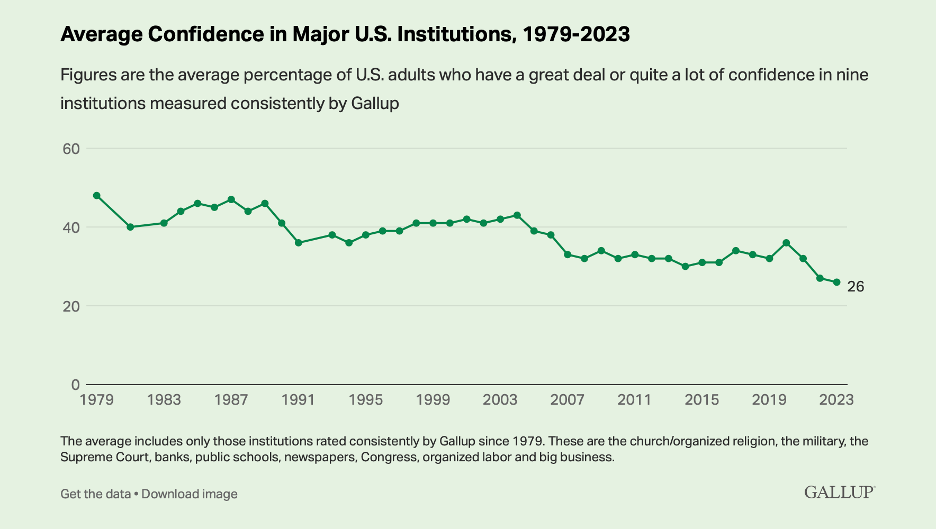
Source: Saad L. Historically Low Faith in U.S. Institutions Continues. Gallup Web site. https://news.gallup.com/poll/508169/historically-low-faith-institutions-continues.aspx. Published July 6, 2023. Accessed April 19, 2024.
Now that we are moving into roughly the tenth year of this period of division and mistrust, there are reasons to be hopeful that we have collectively caught on to the dangers of these forces and are taking modest but meaningful steps to address them and bridge the gaps they have done so much to widen. These steps include the simple recognition, shared by many, that we cannot go on like this, that we must shape a new means of engaging with each other for the good of our collective national project, that “a house divided against itself cannot stand.” On a personal level, I also have been encouraged by the response to my book, “Within Reason.” The book was written as a good-faith, nonpartisan effort to address some of public health’s recent shortcomings. Just a few years ago, such a book might have been greeted with hostility rather than with the fair hearing it received. This reflects, I think, a willingness on the part of many to try to look beyond partisan blinders, to engage with the people and perspectives with which we may disagree without assuming the worst about them. This is all very much to the good.
It is apparent to me, as I try to read and learn from others, that we as a world of ideas are making an effort to think carefully about what divides and unites, and to push back against those who would do the former and to encourage those who would do the latter. For this reason, I have been reflecting more and more about language, and about how language contributes to healing divides and allowing us to achieve our goals, to promote a healthier world. Toward supporting such language, I would like to reflect here on shaping language that can do some good in this moment by embracing a rhetoric of trust and inclusion, toward creating a healthier, less divided world.
I credit a colleague and friend, Dean Harvey Young, who leads the Boston University College of Fine Arts, for a term I find useful. In a conversation, Harvey used the term “a rhetoric of distrust,” and he pointed to examples such as the words used to sow conspiracy theories about vaccines, and words used to create policies that callously leave many behind through the use of rhetoric that dehumanizes the “other.” I thought this formulation was compelling, distressingly so. Words matter. We have all heard some version of, “Sticks and stones can break bones, but words cannot hurt,” which is perhaps superficially true, but, on a deeper level, an underestimation of words’ power to shape reality for many. Words are closely linked to ideas, and the ideas we bring into the world are the basis for what the world will become. Do we want a world that is formed by words and ideas that sow hatred and distrust? Are we really OK with the last decade serving as a template for what the rest of the 21st century will look like? Or will we aspire to something better, and choose to use words that are worthy of such a vision?
Dean Young’s remarks pushed me to think about the converse of “a rhetoric of distrust,” that is, a rhetoric of trust and inclusion. What might such a rhetoric look like? How might it promote the work of those who are interested in the health of the public? Reflecting a bit on this, and on others who have written on related topics, I think I alight on four criteria for a language of trust that surely we want to cultivate if we are to shape a rhetoric that truly supports progress in pursuit of health.
First, we want language that does not distance. That means never using “us vs. them” language; instead, aiming to use language that leans into “us,” reflecting our collective investment in building a better world. There is a line from the novel “Cloud Atlas”: “All boundaries are conventions, waiting to be transcended. One may transcend any convention if only one can first conceive of doing so.” To conceive of transcending the boundaries that emerge between people and groups, we should embrace a language that no longer encodes division in what we say, how we think. This means taking care to speak, as often as possible, of the group, with no one excluded, reflecting a perspective that helps us to imagine a world no longer characterized by the divides of the moment.
Second, we should use language that centers persons, always representing the individual first rather than characteristics of identity. We should not be in the habit of referring to a person as “that [fill in the blank with trait, illness, or disability] person,”; rather, we should speak to who they are as individual persons. This can be difficult; as humans, we are, to a large extent, hardwired to process our interactions through the lens of stereotypes. It can be difficult to look past our biases, past the sometimes-lazy mental shorthand we use to think about people, to see the full humanity of the people around us. But it is necessary that we do so, just as it is necessary that we try to transcend our human tendency toward hate, conflict, and fear of “the other.” We cannot trust people if we do not know them, and we cannot know them if we do not make the effort to see them for who they truly are, rather than as a mere bundle of characteristics.
Third, we should use language of collective responsibility and ownership, rather than of individual ownership, so it is not “my team” but “our team,” not “my community” but “our community.” Such phrases can help shape a more inclusive pursuit of health, by embedding in the very words we say a sense that we are “all in this together.” I have long argued that public health should be a big-tent movement, appealing to as many people as possible, reflecting the universality of the goal of better health. Such movements are about “we,” not “I.” No single individual can create a healthier world by working alone. Likewise, the work of bridging the divides of this moment is work in which we all can, must, take part. By reflecting the collective nature of this enterprise, each word we say can be a step in the right direction, toward overcoming the divisions we have seen. This also can help build much-needed bonds of trust, through the understanding that we are all fundamentally on the same “team,” that we all want a healthier world for ourselves and for our children. When our language reflects our common mission, when it is inclusive in pursuit of what is good for us, collectively, it can help repair the trust that has been so badly damaged by the last decade.
Fourth, we should use language that reflects how people actually talk. This means avoiding jargon and phrasing our arguments in ways that reflect the natural speech of the wider community. I have been thinking a bit lately about Mark Twain, in light of Ron Chernow’s new biography of the author. Twain held some very progressive social views for his time, including a hatred of slavery, and he used his work to argue for a better world. He did so by writing stories that reflect how ordinary people in the 19th century spoke, inventing characters whose speech sounds utterly authentic. This has created challenges for modern ears, most notably the long-standing controversy over racial rhetoric in “The Adventures of Huckleberry Finn,” but it had the effect of advancing a vision of a more just society in a way that resonated deeply with the public, both in Twain’s day and in ours. We could do worse than to aspire to Twain’s ear for the language of the people and his zest for finding the poetry and persuasive power in everyday speech.
Can language make a difference? I have long felt it can, both spoken and written. History is replete with examples of when language changed how we think, and, as such, we have a responsibility to think about how to speak well in our space, to meet our professional responsibility. As with much else, this is not easy, and requires a habit of mind, and we get it wrong (I know I do) regularly, but over time, it is not only what we talk about when we talk about health that changes, but also how we talk when we talk about health. When this reflects a rhetoric of trust and inclusiveness, it can be an enormous positive indeed.
__ __ __
Also this week
New JAMA Health Forum Conversation on “Changes in policy and the health of LGBTQ+ populations” in conversation with Dr Gilbert Gonzales https://jamanetwork.com/journals/jama-health-forum/pages/editors-summary-podcast . An accompanying editorial is here.
I spoke to NPR about the recent JAMA Health Summit report on firearms, a topic of particular relevance here in St Louis.
Next weekend is thanksgiving, so I will pause on Goldfish until the first week of December. I hope that everyone has a moment to rest, spending time with loved ones during the thanksgiving break. There is much to give thanks for, even as we come to the end of a tumultuous year. I hope to reflect a bit on the year that has been, and potential for the coming year in upcoming Goldfish essays. Warmest wishes for thanksgiving to everyone.
Sandro, this is a vital contribution. Your call for a "rhetoric of trust" is not just timely; it is urgent. The four criteria you laid out—especially the shift away from clinical jargon toward "Mark Twain" authenticity—are the bedrock of reconnection.
However, in the spirit of expanding this "big tent," I would offer one structural addition to your framework.
We must be careful not to confuse manner (how nicely we speak) with matter (how well we deliver).
While reforming our language is necessary, I worry it is insufficient. The data on declining trust (which you cited) suggests that the public hasn't just tuned out our tone; they have tuned out our judgment.
To truly rebuild the "fabric of trust," our new rhetoric must be anchored in two things that often go unspoken:
1. The "Certainty Trap" One of the greatest drivers of distrust wasn't just that public health used "us vs. them" language; it was that we often communicated hypothesis as fact. When we speak with 100% certainty on data that is only 60% mature—and then have to reverse course—we look like we are gaslighting the public. A true rhetoric of trust requires Epistemic Humility. It requires the bravery to say to the public: "We don't know yet," or "This is our best guess today, but it might change tomorrow." Vulnerability builds trust faster than authority does.
2. Competence is the ultimate inclusive language. We can use the most inclusive phrasing in the world, but if a rural mother drives two hours for a paediatric appointment only to be turned away, or if a patient navigates a fragmented labyrinth of billing, the trust is broken before a word is spoken. Sometimes, we focus on "distancing language" while ignoring "distancing logistics."
3. Balancing "We" with "I" You rightly advocate for language of collective responsibility ("our team"). This is crucial. But to reach the specific demographic that has lost the most faith in institutions (the skeptical 40-50%), we must also honour Individual Agency. Public health often fails when it sounds like a mandate rather than a partnership. The "Big Tent" must be large enough to hold those who prioritize liberty alongside those who prioritize safety.
The Takeaway: Let’s absolutely adopt your four points. They are excellent. But let’s ensure this "new rhetoric" is the wrapper for a product—public health delivery—that is humble regarding what it knows, and relentlessly competent in what it does.
We can't just talk our way back to trust; we have to perform our way back.
Thank you for leading this conversation, "old" friend!
If a healthier future for all is our collective goal, then our diverse backgrounds become an asset for sustainable progress. It is not “them versus us,” but rather “we for us.”